Lion Grove Garden
Shizi Lin
I. Origins: From Abandoned Residence to Zen Monastery
The Lion Grove Garden was originally a derelict residence of a Song Dynasty official. In the first year of the Zhizheng era of the Yuan Dynasty (1341 CE), the eminent Buddhist master Tianru Weize arrived in Suzhou to deliver sermons and was warmly received by his disciples. At that time, Master Tianru resided at the Huanzhu An hermitage in Yandang Village outside the Chang Gate. The following year (the second year of Zhizheng), he came to the eastern part of Gusu and discovered a place with “several acres of land, ancient trees and dense bamboo groves like those in the mountains,” with an exceptionally quiet environment. Having studied Zen for 18 years at Mount Tianmu in Zhejiang, he decided to establish a Buddhist monastery here. Upon learning of his intention, his disciples collectively contributed funds, purchased land, and built a house to create a Zen grove for Master Tianru. This unique temple was named Puti Zhengzong Temple (Bodhi Orthodox Temple).
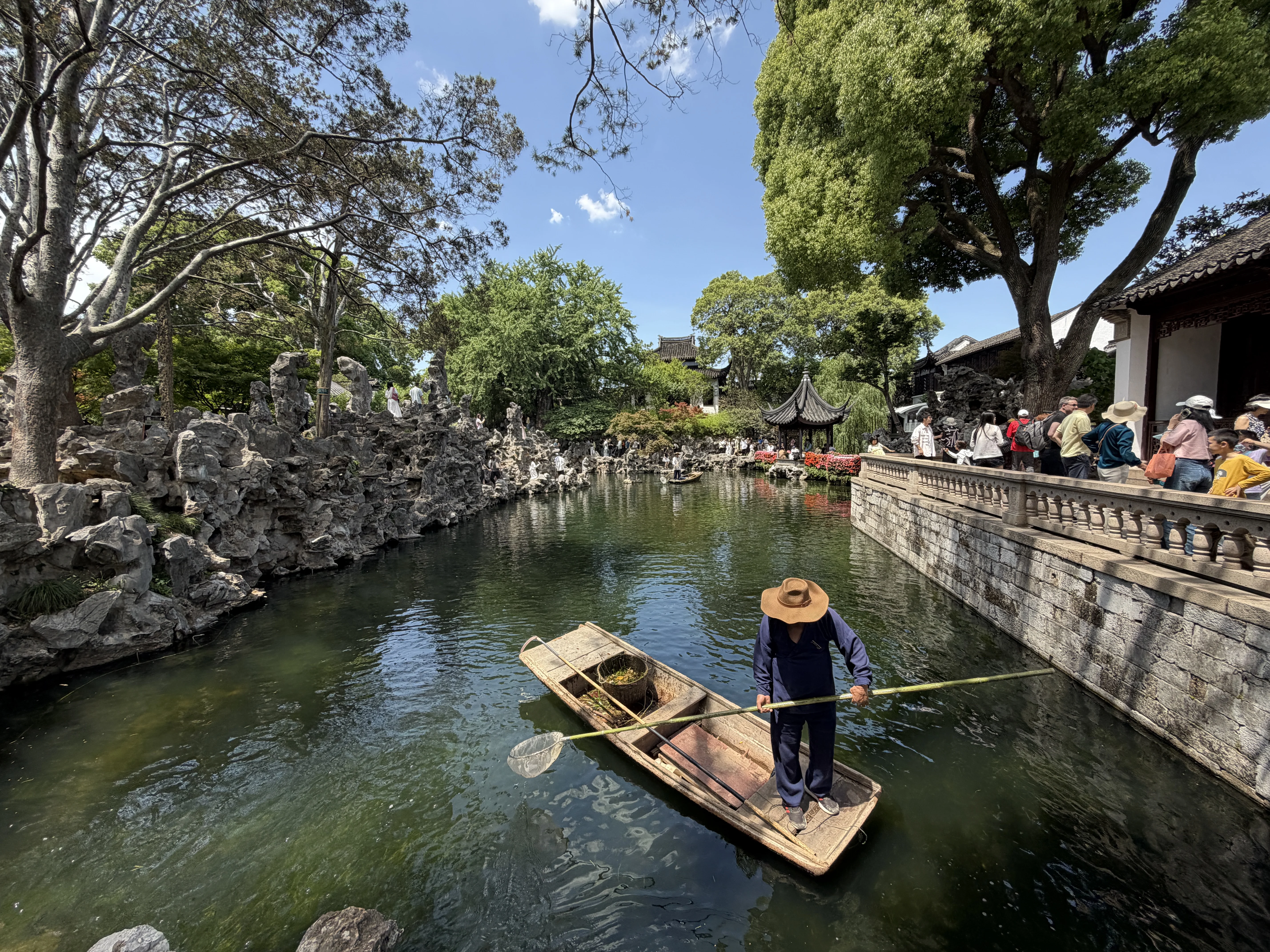
The temple grounds featured “tens of thousands of bamboo stalks, with numerous strange rocks beneath them resembling lions (suan ni).” The term “temple” has long had the alternate names of “jungle” or “Zen grove.” The temple also possessed a magnificent group of Taihu rockery mountains. These large and small Taihu rocks, though varying in shape, mostly resembled the form of lions—standing or reclining, facing upward or downward, displaying a thousand different postures, gazing gracefully in all directions, and creating a remarkably mystical atmosphere through their forest-like arrangement. By combining the form of lions with their symbolic meaning, the place came to be called “Lion Grove Garden.” As the eminent monk Weize wrote in his poem: “People say I dwell in the city, yet I feel as if I am among ten thousand mountains.”
II. Buddhist Zen Significance: The Sacred Site of Lion’s Roar and Dharma Transmission
According to Buddhist legend: When Buddha Shakyamuni was born, he pointed one finger to heaven and one to earth, making the great lion’s roar: “In heaven and on earth, I alone am supreme.” Lions are regarded as divine beasts in Buddhism, and when the Buddha preached, it was called the “lion’s roar.” Buddhist scriptures also state: “The Buddha is the lion among men; wherever the Buddha sits, whether on a bed or on the ground, it is called the lion’s seat.” Master Tianru’s teacher, Mingben (also known as Zhongfeng), received his ordination at the Lion Garden beside Lion Rock on Mount Tianmu in Zhejiang, and Master Tianru himself had also resided at Lion Cliff. Therefore, to commemorate the master-disciple lineage of Buddhist transmission and to express Master Tianru’s determined commitment to spreading the Dharma, the rear garden of Puti Zhengzong Temple was named Lion Grove Garden.
There is also a folk legend in Suzhou: After the completion of Puti Zhengzong Temple, one day the national teacher and divine monk Zhongfeng arrived at the temple riding an eight-zhang tall suan ni (lion). Seeing the many rock formations resembling suan ni, the divine lion mistakenly thought he had returned to the lion herd in the Buddhist paradise. Joyfully jumping and rolling about, he revealed his true form and transformed into Lion Peak, the crowning summit of the garden’s peaks. The scattered lion hairs transformed into more than 500 lions of various sizes and forms, surrounding Lion Peak in worship. In the central part of Lion Grove Garden, five peaks rise from the great artificial mountain, with the highest one shaped like five lions—this is Lion Peak.
Lion Grove Garden is the only surviving “Zen” garden, and most of its architectural names are related to Zen koans.
Lixue Tang (Standing in Snow Hall) — Located in the eastern part of the garden, it was later inscribed by Tang Yin. It derives its meaning from the Buddhist典故 of “standing in snow at the Buddhist gate.” This is the story of severing an arm while standing in snow: Legend has it that the monk Shenguang, in order to seek the Dharma from Bodhidharma, stood in attendance during winter snow, his knees buried in snow yet remaining motionless with palms together. To demonstrate his sincerity, Shenguang severed his arm, dyeing the snow red, and finally received Bodhidharma’s transmission of the robe and bowl, receiving the Dharma name “Huike” and becoming the Second Patriarch of Zen. This is the Buddhist典故 known as “transmitting the scriptures while standing in snow” and “severing an arm to seek the Dharma.”
Zhibai Xuan (Pointing at Cypress Pavilion) — Derives from the典故 of “Zhaozhou pointing at the cypress.” A disciple once asked the monk Congnian why Bodhidharma came from the West. Congnian simply replied, “The cypress tree in the courtyard,” meaning that cypress seeds grow on cypress trees according to the natural law of flowering and fruiting. The Ming Dynasty poet Gao Qi wrote: “When people come asking, I do not answer, but smile and point at the cypress in the courtyard.” Zhibai Xuan is a two-story building, its full name being “Yifeng Zhibai Xuan” (Bow to the Peak and Point at the Cypress Pavilion). Several ancient cypress trees stand before the pavilion, echoing the rock peaks in the distance, making it one of the main scenes in Lion Grove Garden.
Wenmei Ge (Asking about Plum Pavilion) — Related to the典故 of Mazu asking about plum blossoms. The Tang Dynasty Zen master Mazu Daoyi practiced sitting meditation, and Nanyue Huairang enlightened him with the metaphor of “grinding a brick to make a mirror”: “If grinding a brick cannot make a mirror, how can sitting in meditation make you a Buddha?” Mazu was suddenly enlightened. Wenmei Ge is named after this koan, embodying the Zen principle of not being attached to form but pointing directly to the human mind.
Woyun Shi (Lying in Clouds Chamber) — The name “Woyun” (Lying in Clouds) comes from a poem by the Jin Dynasty poet Yuan Haowen: “When shall I lie in clouds, following the seasons and growing leisurely lax.” This chamber was built on flat ground in the center of the artificial mountain, originally serving as a meditation room where monks sat in stillness to concentrate their minds and cease distractions. Surrounded by layered rock peaks resembling groups of lions dancing, the small building appears to lie upon the mountain peaks. Ancient people believed that clouds were born from touching stones, and called stones “cloud roots.” In the summer of 1922, Cheng Dequan (who had served as Governor of Jiangsu Province) inscribed the plaque for Woyun Shi. Four years later, he became a monk at Tianning Temple in Changzhou and was buried beside Hanshan Temple after his death.
III. Geographic Setting: Shilin Temple Lane and the Ancient City’s Waterways
The Lion Grove Garden is located in the northeastern corner of the ancient city of Gusu, forming a close spatial connection with the surrounding streets and waterways. Shilin Temple Lane, beside Panjia Bridge, is the lane where the garden is located. At the end of the Yuan Dynasty, Pan Yuanshao, the son-in-law of Zhang Shicheng, resided in this area with an expansive property that included the Lion Grove Garden. In the Ming Dynasty, the property was transferred to Pan Shiyong, and the “Republic of China Wu County Gazetteer” renamed it Pan Shiyong Lane, now known as Panru Lane.
For those working in the ancient city, looking out their windows in the morning, they can catch the sunrise casting its glow upon the pink walls and dark tiles of the Lion Grove Garden—one of the most typical morning scenes in the ancient city of Suzhou. The adjacent streets, such as the Shilin Temple Lane directly connecting to the west end of Qinglin Bridge, form a pattern where the city’s waterways and famous gardens are intimately intertwined.
IV. Status Among Gardens: One of Suzhou’s Four Great Gardens
The Lion Grove Garden is listed alongside Canglang Pavilion, the Humble Administrator’s Garden (Zhuozheng Yuan), and the Lingering Garden (Liu Yuan) as the four great gardens of the Song, Yuan, Ming, and Qing dynasties in Suzhou. If Canglang Pavilion represents the clear and spacious elegance of Song Dynasty literati gardens, the Humble Administrator’s Garden reflects the reclusive ideal of Ming Dynasty scholar-officials, and the Lingering Garden embodies the exquisite grandeur of Qing Dynasty merchant gardens, then the Lion Grove Garden stands as a unique example of Yuan Dynasty Buddhist garden aesthetics with its distinctive Zen atmosphere and rock artistry.
The garden is world-renowned for its rockery mountains. These Taihu rockeries are winding and intricate, with deep caves and hidden valleys. Visitors wandering through them feel as if they have entered a labyrinth. Among the rock peaks, some resemble crouching lions, some hold their heads high, and some depict mother and child in tender embrace—each with a different form, full of charm and interest. This gardening technique of “mountains and forests within an arm’s reach” condenses the charm of natural landscapes into the limited space of the city, embodying the highest realm of Chinese classical gardens: “Though made by human hands, it appears as if opened by nature.”
V. Conclusion
From its founding by Master Tianru Weize in the Yuan Dynasty to its present status as part of the World Cultural Heritage, the Lion Grove Garden has traversed nearly seven hundred years of history. It is not merely a garden, but a three-dimensional Zen scripture—every Taihu rock is a koan, and every hall contains a story of Dharma transmission. The unique quality of Lion Grove Garden lies in its integration of Buddhist solemnity, garden elegance, and the rustic charm of rocks, creating a one-of-a-kind “Zen aesthetic.” As Master Weize wrote: “People say I dwell in the city, yet I feel as if I am among ten thousand mountains”—in the depths of Gusu’s bustling prosperity, the Lion Grove Garden preserves a pure land of Zen amidst ten thousand mountains for the world.